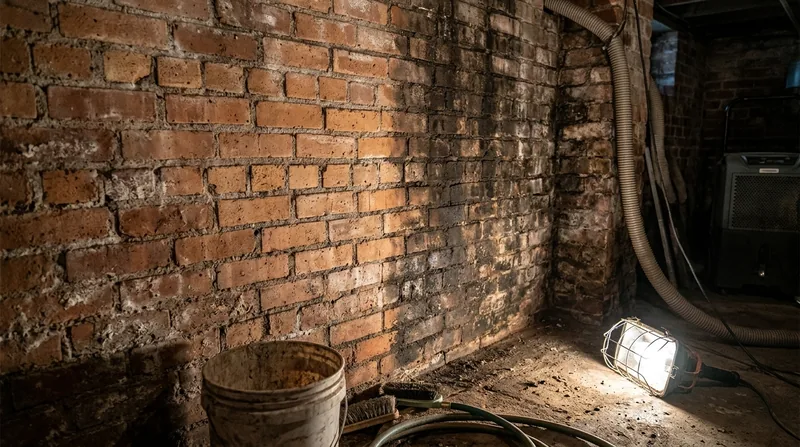




Chattanooga sits in a bend of the Tennessee River below Lookout Mountain, and that geography puts a lot of water against a lot of old foundations. Victorian and Queen Anne homes in Fort Wood and St. Elmo still sit on 1880s brick and stone footings, while full basements on the sloped lots of North Shore and Riverview take runoff from the ridges above. When that water finds a footing drain that has silted shut or a wall that has lost its parging, the basement stays damp through Chattanooga's long humid summers, and the musty smell shows up before the stain does. Basement Mold Remediation in Chattanooga starts with finding the moisture source, not with spraying the visible growth. We contain the affected area, treat the building materials, and then fix the water path so the mold does not come back after the first spring storm. If you are still at the diagnostic stage, start with a free basement inspection so we can trace where the moisture is entering.
Why Basement Mold Remediation Matters in Chattanooga's Old Brick and Red Clay
Chattanooga gets some of the heaviest rainfall of any US city, and the soil here holds it. Red clay on the slopes and creek bottoms along South Chickamauga Creek drains slowly, so water sits against the foundation long after the storm passes. On Lookout Mountain and Signal Mountain, sandstone caprock over limestone valleys sends water sideways through karst, and mountain homes stepping down steep wooded lots collect it in walk-out basements. Older brick and stone foundations in Highland Park and Brainerd were never built with a modern waterproof membrane, so moisture wicks through the mortar and shows up as efflorescence, then as mold on the joists and drywall.
- Brick and stone foundations in Fort Wood and St. Elmo wick groundwater through mortar joints and feed mold behind finished walls.
- Hillside homes on Lookout Mountain and Signal Mountain take hydrostatic pressure on the uphill wall after every spring storm.
- 1950s to 1970s brick ranches in Brainerd and East Ridge have lower levels with original drain tile that has long since clogged with clay and roots.
- 1990s to 2020s poured walk-out basements in Ooltewah, Hixson, and Collegedale grow mold along the cold joint when the sump pump fails during a heavy rain.
In every one of those cases, the mold is a symptom of a moisture problem that will keep feeding it until the water path is corrected.
Key info: A home in St. Elmo with a stone foundation and original weeping tile will grow mold every summer until the interior perimeter drain is restored. Treating the mold without fixing the drain is a temporary fix that fails by July.
If you want to understand the drainage side of the fix before you call, the City of Chattanooga's building permits page at chattanooga.gov explains when a drainage or foundation alteration needs a permit.
How We Handle Basement Mold Remediation in Chattanooga Homes
We work from the water backward. Before we touch the mold, we map the moisture: wall readings, humidity levels, and a visual trace of where water enters during a rain event. That tells us whether the problem is a crack that needs epoxy injection, a failed drain tile that needs replacement, or a sump basin that overflows because the pump is undersized for the volume coming off a Signal Mountain slope. Only then do we set up containment and begin remediation.
- We inspect the basement and foundation, including wall base, joists, and any finished surfaces, and record moisture readings room by room.
- We set up containment with plastic sheeting and negative air pressure so spores do not spread into the living space above.
- We remove porous materials that cannot be saved, such as saturated drywall, insulation, and wood that has lost its structure.
- We treat the remaining surfaces with an antimicrobial application and HEPA vacuum the area after the growth is physically removed.
- We correct the moisture source, whether that means sealing a wall, restoring the interior drain tile, or replacing a failed sump pump.
- We dry the space with commercial dehumidifiers and air movers and verify moisture content before we close out.
That last step is the one most homeowners skip, and it is the reason mold returns in the same corner the following summer.
Key info: A Red Bank split-level we worked on had mold along the entire lower wall of a finished room. The source was a downspout that discharged within two feet of the foundation, sending roof water straight into the clay against the wall. We extended the discharge line, sealed the wall, and remediated the drywall. No excavation was needed.
When the fix calls for restoring perimeter drainage, we install an interior drain tile system tied to a sump basin, which is often the better answer than exterior excavation on a finished basement.
Remediation Approaches We Use in Chattanooga Basements
The right approach depends on how far the moisture has spread and what the building materials are. Here is how the main methods compare for the foundation types and climates we see around Chattanooga.
| Approach | Description | Best for |
|---|---|---|
| Surface treatment and HEPA cleaning | Physically remove growth from joists and concrete, HEPA vacuum, and apply an antimicrobial to the cleaned surface. | Small areas of surface mold on unfinished basement walls and framing. |
| Containment and material removal | Seal the work area with plastic and negative air, then remove saturated drywall, insulation, and damaged wood. | Finished basements where mold has spread behind drywall or under flooring. |
| Moisture source correction | Seal wall cracks, restore drain tile, replace a failed sump pump, or extend downspouts away from the foundation. | Any basement where the mold returns after treatment, which means water is still entering. |
| Humidity control and drying | Run commercial dehumidifiers and air movers, verify moisture content, and set up ongoing humidity control for the humid season. | Chattanooga's long humid summers, where ambient moisture alone can feed mold on cool basement surfaces. |
| Vapor barrier and wall sealing | Install a vapor barrier on the wall and seal the wall surface to stop moisture vapor from reaching the interior. | Brick and stone foundations that wick moisture without an active leak. |
Each of these approaches addresses a different part of the same problem, and most jobs combine two or three of them.
Basement Mold Remediation Cost in Chattanooga: What to Expect
Most basement mold remediation in Chattanooga starts around $1,500, and that figure covers a contained area with surface treatment, HEPA cleaning, and basic drying. The number moves up with the size of the affected area, whether finished materials have to come out, and whether the moisture source correction is a simple downspout extension or a full interior drain tile restoration. A finished basement in Ooltewah with mold behind the drywall costs more to remediate than an unfinished wall in Red Bank with surface growth only.
We recommend getting two or three estimates, and we recommend asking each contractor whether the quote includes the moisture source fix or only the mold treatment. A quote that treats the mold without addressing the water will be the cheapest number you get and the most expensive decision you make. Our full pricing overview breaks down the ranges by scope so you can compare estimates on the same basis.
What to Look for When Hiring a Basement Waterproofing Contractor Near Me in Chattanooga
Mold remediation and waterproofing overlap, and the contractor you hire should be able to handle both sides. Ask for proof of licensing and insurance before work begins, and ask whether the company carries general liability and workers' compensation coverage. Get at least two written estimates that specify what will be removed, what will be treated, and what will be done about the water source. Ask for local references, ideally from a homeowner with the same foundation type as yours, because a brick and stone foundation in Highland Park behaves differently from a poured wall in Collegedale.
Permits matter here. Structural foundation repair, egress window cutting, and work that alters drainage or the sanitary connection of a sump discharge commonly require a permit, and the thresholds vary by jurisdiction. Always confirm the current requirements with the local building department before work starts. If your home is in a neighborhood with HOA rules, check those before scheduling exterior drainage work as well. You can reach us through the contact page to schedule an estimate and ask about credentials, and we will provide a certificate of insurance on request.
One more thing to check: ask whether the contractor belongs to a trade association that holds members to a standard. We are a member of the Basement Health Association, and that membership requires adherence to industry standards for below-grade work. It is not a substitute for licensing, but it tells you the company is accountable to someone beyond itself.
Basement Mold Remediation in Chattanooga: Pricing Guide
| Service | Price | Details |
|---|---|---|
| Surface mold treatment | Starting at $1,500 | Includes containment, HEPA cleaning, antimicrobial application, and drying verification for a single unfinished basement area. |
| Finished basement remediation | Starting at $2,800 | Covers removal of saturated drywall and insulation, containment with negative air, and treatment of the exposed framing. |
| Remediation with drainage correction | Starting at $4,500 | Adds wall sealing or drain tile restoration so the moisture source is corrected, not just the visible growth. |
| Complex or large-scale job | On estimate | Multiple rooms, widespread growth, or structural moisture damage needs an on-site inspection before we quote a number. |
| Travel | Included | In Chattanooga and surrounding areas, no separate call-out or mileage fee. |
| Estimate | Free | Response within 24h at (423) 275-4684, no obligation to book. |
Indicative pricing, the exact cost depends on square footage, finish, and site access. Free personalized estimate within 24h at (423) 275-4684.


