



Why Bowing Walls Are a Real Problem in Chattanooga's Sloped Neighborhoods
If you live on a ridge or a hillside lot in Chattanooga, your basement wall is doing more work than most. Homes stepping down the slopes of Lookout Mountain and Signal Mountain, and full-basement homes on the North Shore and Riverview, sit against saturated slope soil that pushes hard on the uphill block wall. That lateral load is hydrostatic pressure, and when it exceeds what the wall was built to take, the wall starts to bow inward.
We perform Bowing Wall Repair in Chattanooga to stabilize walls that have moved, not just to hide the symptom. The fix depends on how far the wall has deflected, what soil is pressing on it, and whether water is still feeding the pressure. Basement waterproofing often runs alongside the structural work because a stabilized wall that still takes water will keep moving.
Why Bowing Wall Repair Matters on Chattanooga's Ridges and River Slopes
Chattanooga sits in a bend of the Tennessee River below Lookout Mountain, with sandstone caprock on the ridges over limestone valleys. Red clay on the slopes holds water, and the city takes some of the heaviest rainfall of any US city. Spring storms dump inches in hours, and that water loads the uphill wall of every ridge-side basement.
- Older brick and stone foundations in Fort Wood and St. Elmo were never built for modern storm volumes, so they crack and rotate at the mortar joints.
- Bungalows and Tudors in Highland Park often have shallow foundations that move when clay soil swells after a wet spring.
- Walk-out basements on Lookout Mountain and Signal Mountain take direct pressure on the uphill wall, which is the classic bowing pattern we see.
- 1950s to 1970s brick ranches in Brainerd, Red Bank, and East Ridge show horizontal cracking and inward lean when footing drains have failed.
- Newer poured walk-out basements in Ooltewah, Hixson, and Collegedale can bow too when backfill was poorly compacted or downspouts dump next to the wall.
Ignoring a bowing wall lets the movement accelerate, and a wall that leans past a certain point cannot be straightened without major excavation. Call (423) 275-4684 as soon as you see a horizontal crack or a wall that is no longer plumb.
Key info: On Lookout Mountain and Signal Mountain, the uphill basement wall is the one that bows most often. The sandstone caprock sheds stormwater downslope, and the clay below holds it against the foundation. If you see efflorescence or a horizontal crack on that wall, the pressure is already active.
Structural repair of a foundation wall is regulated work in Tennessee, and local building departments set their own thresholds. Check the Hamilton County government site and your city building department before work begins.
How We Repair a Bowing Wall in Chattanooga
We start by finding out why the wall moved. That means checking the soil side, the footing drain, the grading, and the downspouts, not just the crack pattern inside. A wall that bowed because of water pressure needs the water addressed or the repair will not hold. We map the deflection with a plumb line and measure how far the wall has traveled before we recommend a method.
- We inspect the wall, the footing, and the drainage on the uphill side, and we note any efflorescence or water staining that tells us how often the wall gets wet.
- We measure the bow with a string line and record the deflection at mid-height, because the amount of movement decides whether straps, anchors, or beams are appropriate.
- We correct the water source first, often with exterior basement waterproofing or drain work, so the repaired wall is not pushed again.
- We install the chosen stabilization system, torque it to spec, and verify the wall is held at its current position or brought back within tolerance.
- We seal the wall face and close out with a written summary of the deflection readings so you have a baseline for future checks.
The order matters. Stabilizing a wall before the water is controlled is the most common reason a repair fails, and we will tell you when drainage is the real job.
Key info: A 1920s bungalow in Highland Park had a block wall bowing about 1.5 inches at mid-height after years of downspouts discharging at the corner. We extended the downspouts, installed carbon fiber straps, and the wall has held its position through two wet springs. No excavation was needed.
Matching the Repair Method to the Wall and the Soil
There is no single fix for a bowing wall. The right method depends on how far the wall has moved, whether it is block or poured concrete, and how much soil pressure is behind it. We choose from four approaches and explain why one fits your wall better than another.
| Approach | Description | Best for |
|---|---|---|
| Carbon fiber straps | Straps bonded vertically to the interior wall face and anchored at the floor and sill. | Block walls with moderate bowing and no need to pull the wall back. |
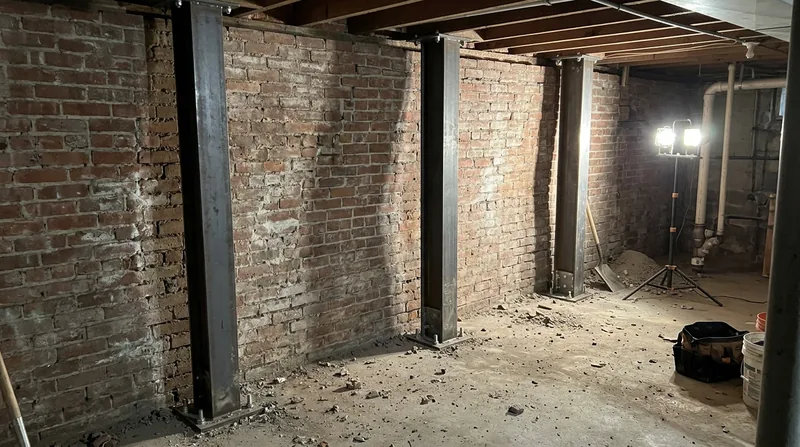
| Steel I-beams | Vertical steel beams set against the wall and tied into the floor structure. | Heavier movement or walls where straps alone will not hold the load. |
| Wall anchors | Interior plates tied to exterior earth anchors through the wall. | Walls that need to be pulled back toward plumb over time. |
| Drainage correction | Footing drain repair, grading, and downspout extension to relieve pressure. | Walls that moved because of water, used alone or with stabilization. |
We will tell you plainly when a wall only needs drainage work and when it needs structural stabilization. That honesty is the difference between a repair that lasts and one that gets redone.
Bowing Wall Repair Cost in Chattanooga: What to Expect
Bowing wall repair pricing starts from $600 for the smallest scope, typically a single strap or a limited drainage correction. Most real repairs land well above that because the work involves structural hardware, engineering judgment, and often water control on the uphill side. The bigger the deflection and the more access work required, the higher the number.
- The length of wall that has moved drives material and labor more than anything else.
- Whether the wall needs to be pulled back to plumb adds time and anchor hardware.
- Access on steep Lookout Mountain and Signal Mountain lots can require extra staging.
- Drainage correction on the uphill side is sometimes a separate line item from the structural work.
- Engineering review, when required by the local building department, adds a step to the schedule.
Get two or three written estimates and compare what each one includes, not just the bottom line. A low number that skips drainage correction is not the same job. Our pricing overview lays out the ranges we work from.
Hiring a Bowing Wall Repair Contractor Near Me in Chattanooga
Ask for proof of licensing and insurance before anyone touches your foundation, and call the references on the list. A contractor who has stabilized walls in Chattanooga's clay and on the ridges will talk about drainage and soil, not just hardware. Confirm who pulls the permit, since structural foundation repair commonly requires one and the rules vary by jurisdiction.
Ask how they will measure the deflection and whether they will give you the readings in writing. Ask what happens if the wall moves after the repair, and get the warranty terms in writing, including whether it transfers if you sell. A specialist who works below grade every day will answer these questions without hesitation.
We are a Basement Health Association member and we specialize in below-grade work, not general foundation repair. Reach out through our contact page to set up an inspection, and we will tell you what your wall actually needs.
Bowing Wall Repair in Chattanooga: Pricing Guide
| Service | Price | Details |
|---|---|---|
| Carbon fiber strap installation | Starting at $600 | Covers a single strap on a lightly bowed wall, priced per strap as the wall length grows |
| Steel I-beam stabilization | Starting at $1,200 | Includes beam set and floor tie-in, with cost rising for heavier walls and tight access |
| Wall anchor system | On estimate | Requires exterior excavation and anchor placement, so the soil and slope decide the number |
| Drainage correction add-on | Starting at $800 | Footing drain repair, grading, and downspout extension to relieve pressure on the repaired wall |
| Travel | Included | In Chattanooga and surrounding areas, no separate call-out or mileage fee |
| Estimate | Free | Response within 24h at (423) 275-4684, no obligation to book |
Indicative pricing, the exact cost depends on square footage, finish, and site access. Free personalized estimate within 24h at (423) 275-4684.


